
hERG Screening for Drug Discovery
hERG screening evaluates whether a compound inhibits the hERG (Kv11.1) potassium channel, an important contributor to cardiac repolarisation. Inhibition of hERG can delay repolarisation and is associated with QT interval prolongation and an increased risk of Torsades de Pointes (TdP).
ApconiX provides rapid, high-quality functional hERG screening using automated and manual patch clamp electrophysiology. Our scientists help drug discovery teams identify potential liabilities early, guide medicinal chemistry and make better-informed candidate selection decisions.

Read Dr Michael Morton’s blog on the background to hERG testing: The Reductionist Approach


Why early hERG screening matters
Drugs can have off-target effects. Terfenadine, an antihistamine withdrawn from the market because of its cardiac risks, is a well-known example of the consequences of hERG inhibition.
The ICH S7B guideline, introduced in 2005, describes a nonclinical testing strategy for assessing a compound’s potential to delay ventricular repolarisation.
Testing early for hERG inhibition supports the de-risking of drug pipelines and can help reduce wasted time and costs. Patch clamp electrophysiology provides direct, functional data to characterise a compound’s effects on hERG and support the assessment of safety margins.
A compound that blocks hERG may still have development potential. An integrated approach helps place these findings in a wider cardiac safety context. ApconiX also provides testing of the CiPA ion channel panel, in silico modelling and cardiac MEA.
What you will benefit from
- Access to ApconiX scientists who will tailor our service specifically to your needs and better advise you on your next steps
- High quality ion channel profiling matched to your design-make-test cycle
- An average turnaround time for hERG data of less than 4 days following receipt of customer compounds
- Access to expertise from a broad pool nonclinical safety experts


Our services include:
- Ion channel screening for hERG
- Bespoke assay and cell line development
- Expertly performed direct functional electrophysiology measurements with fewer artefacts than ligand binding or fluorescence assays
- Testing on the latest generation automated electrophysiology platforms (QPatch II and Patchliner) with the capacity for large numbers of compounds
- We additionally provide manual patch clamp services
Cardiac ion channel screening beyond hERG
By working with ApconiX you will benefit from our combined expertise in ion channel electrophysiology and project toxicology to move molecules away from this liability through informed choices in molecule design.
Here’s which ion channels are routinely screened in the pharma industry:
Nav1.5 is cardiac sodium channel, Cav1.2 is cardiac “L-type” calcium channel, Kv7.1 is cardiac lks current
Refine your decision making with a deeper understanding of the potential for effects on cardiac safety to deliver an optimal and de-risked clinical candidate. ApconiX routinely offer sodium and calcium channel assays for a more comprehensive assessment of cardiac liability. On a case-by-case basis we can also deploy other cardiac ion channel assays to suit your needs including cardiac ‘T-type’ calcium channels and Kv1.5 .
Given over 500 years of combined expertise in drug discovery and safety, ApconiX is uniquely positioned to work with your project team to
interpret your data in the context of your drug discovery program.
Flexibility and customer focus
What we need from you:
We only need a few mgs of the compound as a solid or in solution.
We realise not all compounds are soluble in standard organic solvents, e.g. DMSO. Our clients are often looking for ways to increase the solubility of their compounds with a variety of organic and aqueous solvents. We are happy to try a number of solvents which have been validated in our assays.

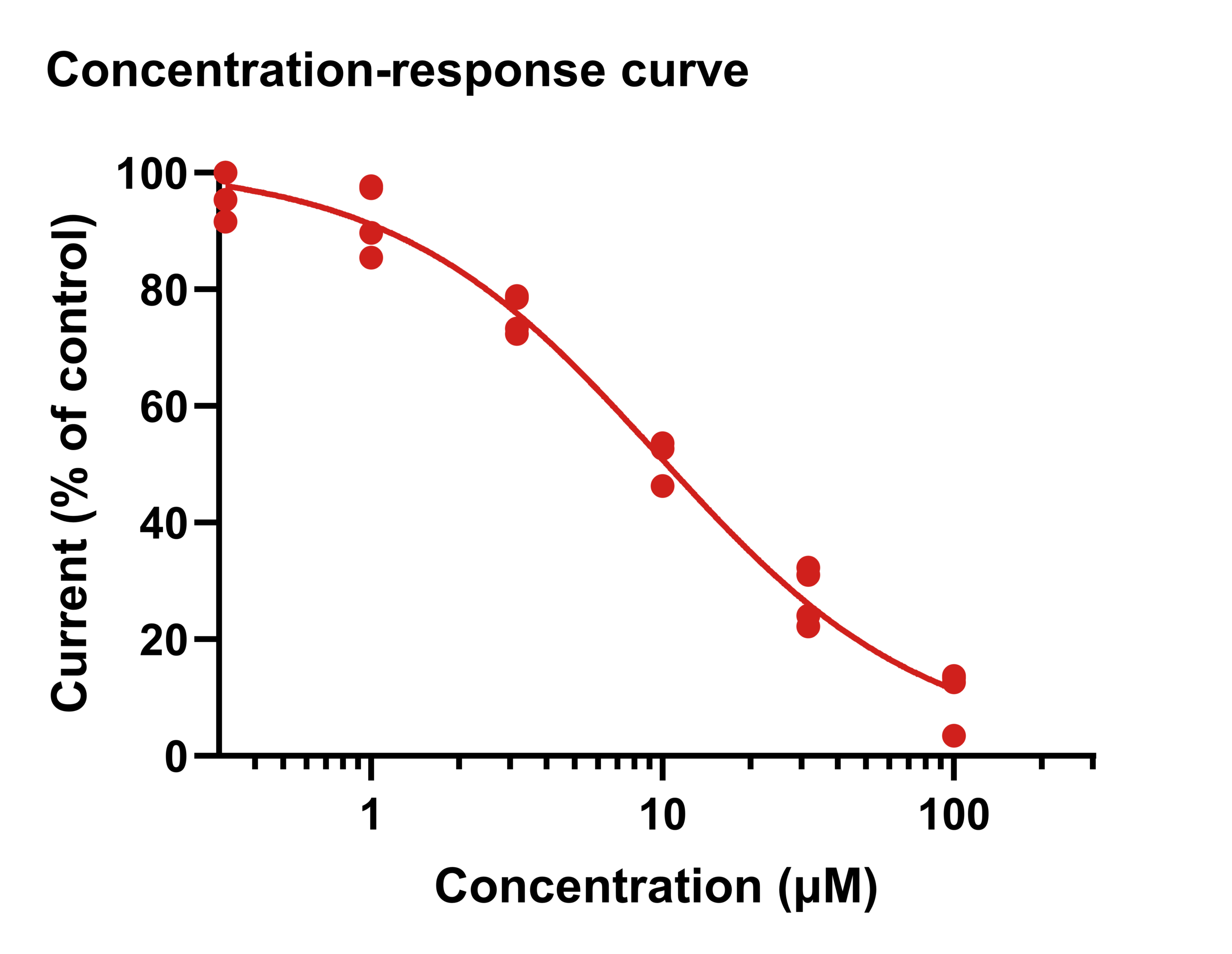
Action of drug, XE991, on Kv4.3 ion channels (Ito current)
What you receive in return:
A report which includes:
- A 6 point concentration response curve
- IC₅₀ measured for each compound
- Methodology, solutions and concentrations used
This is provided within the 4 day turnaround. Each experiment is carried out by and each report is written and reviewed by, an expert electrophysiologist.