Cardiac Safety Assessment in Drug Discovery
A cardiac safety assessment is a process that determines whether a candidate drug is likely to be associated with cardiac liability. An early, thorough, and robust cardiac safety assessment is therefore a crucial step in drug discovery. To accurately determine cardiac liability, it’s not only important to measure a drug’s effect on hERG — but also on other relevant ion channels, and on the overall function of the cardiac cell as a whole. Ultimately, the timely assessment of cardiac safety in drug discovery can avoid the failure of promising drug candidates later in the critical path.
Why assess cardiac safety early in drug discovery?
The failure rate for new drugs between 2000 and 2010 was 91% (Filipova, 2026) and adverse drug reactions in the cardiac field are responsible for almost 10% of market withdrawals (Destere, 2023).
Therefore, to avoid significant time and resource loss, it is crucial to identify and mitigate cardiac safety liabilities as early as possible in the drug discovery pipeline.

Does assessing cardiac safety just mean screening for hERG?
In a word — no.
When it comes to cardiac safety, it’s often assumed we just mean testing for hERG, but assessment of cardiac liability needs to go beyond this to effectively prioritise promising drug candidates and determine clinical risk.
Of course, testing for hERG is important. This is because a block of the hERG ion channel can lead to QT interval prolongation and fatal arrhythmias like Torsades de Pointes (TdP). Therefore, we recommend early non GLP hERG screening ahead of in vivo studies to avoid costly failures later in your critical path.
The Comprehensive In Vitro Proarrhythmia Assay (CiPA) initiative and the ICH S7B Q&A guidance advise drug developers not only to test for hERG, but also to conduct a broader package of preclinical cardiac safety assessments. Relying on hERG assessment alone could increase the risk of discarding a drug-development project that might otherwise reach the market, or of proceeding with a candidate that has unidentified cardiac toxicity.
Consider verapamil, a widely prescribed drug, as an example. Verapamil blocks the hERG potassium channel, but its effects on calcium and sodium channels counteract the proarrhythmic risk that might be predicted from hERG block alone. As a result, verapamil has a low risk of causing Torsades de Pointes (TdP). However, subsequent cardiomyocyte assays have shown that its activity at calcium channels can reduce cardiomyocyte contractility, identifying a different potential cardiac safety concern.

Go beyond hERG with ApconiX
Here at ApconiX, we understand that you need to see the full picture when it comes to early cardiac safety assessment.
We offer a fully integrated service which combines automated electrophysiology, in silico modelling and human induced pluripotent stem cell derived cardiomyocyte (hiPSC CM) assays to deliver:
- Functional measurement of ion channel activity with the latest generation of automated patch clamping platforms (QPatch II and Patchliner)
- CiPA ion channel panel (including hERG, hNaV1.5 peak, hNaV1.5 late, hCaV1.2, hKVLQT1 (IKs current), hKV4.3 (Ito current) and hKir2.1)
- Prediction of the overall cardiac action potential using in silico cardiac modelling and IC50 data
- hiPSC derived cardiomyocyte assays, including high frequency cellular impedance, to determine real time dynamic viability and cytotoxicity and multielectrode array (MEA) to assess functional contractility and electrophysiology across whole populations of cells
How the hERG assay, CiPA ion channel panel, cardiac MEA and in silico modelling all fit together
While hERG, CiPA, cardiac MEA and in silico modelling all address different questions — combining them intelligently is key in designing an effective, integrated cardiac safety strategy.
We therefore offer a bespoke cardiac service that can offer all, or just a subset, of these approaches depending on the specific needs of your project — helping you make better informed project decisions and avoid unnecessarily deprioritising promising compounds.
| Approach | Core Question Addressed | Required Inputs | Primary Outputs | Appropriate Strategic Use |
|---|---|---|---|---|
| hERG screening | Does the compound bind and block the primary repolarising potassium channel in the heart? | Compound: cell line expressing human hERG channels | IC50 values: percentage of hERG current inhibition at specific doses | Early discovery to filter out the most potent hERG blockers |
| CiPA ion channel panel | How does the compound interact with the broader suite of core cardiac channels? | Compound: cell lines expressing seven key human channels | IC50 values and Hill coefficients across all seven target currents | Late lead optimisation to build a comprehensive biophysical profile for computer modelling |
| In silico modelling | How do multiple ion channel interactions collectively impact the human cardiac action potential? | IC50 values and Hill coefficients for multiple channels | Simulated action potential duration (APD): metric scores such as qNet | Lead optimisation to run virtual dose escalations and predict risks |
| Cardiac MEA | How does the drug affect integrated, functional human tissue? | Live hiPSC-CMs; multi-well microelectrode plates | Field potential duration (FPD): beating rate: incidence of early afterdepolarisations (EADs) | Preclinical candidate selection to confirm physiological translation in beating human heart cells |
GLP hERG can also be provided in association with our expert partners.
Who designs and interprets the cardiac safety assessment?
We are an experienced scientific team with an extensive publication record in ion channel pharmacology and safety assessment.
Our ion channel experts offer comprehensive cardiac safety modelling to help you make better informed project decisions and avoid unnecessarily deprioritising promising compounds:
- Michael Morton (PhD) uses latest generation automated patch clamp assays for targeted full concentration response ion channel panel studies. As the head of the lab, Michael oversees all work on cardiac safety
- Sean Brennan (PhD) performs in silico cardiac modelling to predict the overall cardiac action potential using available IC50 data
- Karen Jones (PhD) utilises hiPSC derived cardiomyocyte assays, including MEA, to assess conduction, contractility and cytotoxicity across whole populations of cells
- Hannah Jennings (MSc) works on cell line generation, assay development and patch clamping using latest generation electrophysiology platforms to screen for hERG, CiPA and cardiac liabilities
- Katie Newman (PhD) works as part of the cardiac safety screening team to evaluate client compounds for hERG liability using her expertise in QPatch
- Magali-Anne Maizières (MSc) contributes her extensive experience in ion channel physiology to our client and research work on CiPA panels


What will I receive?
You will receive a detailed report via email, including:
- An account of the work performed, including which member of our team did the work
- Information regarding the experimental methods
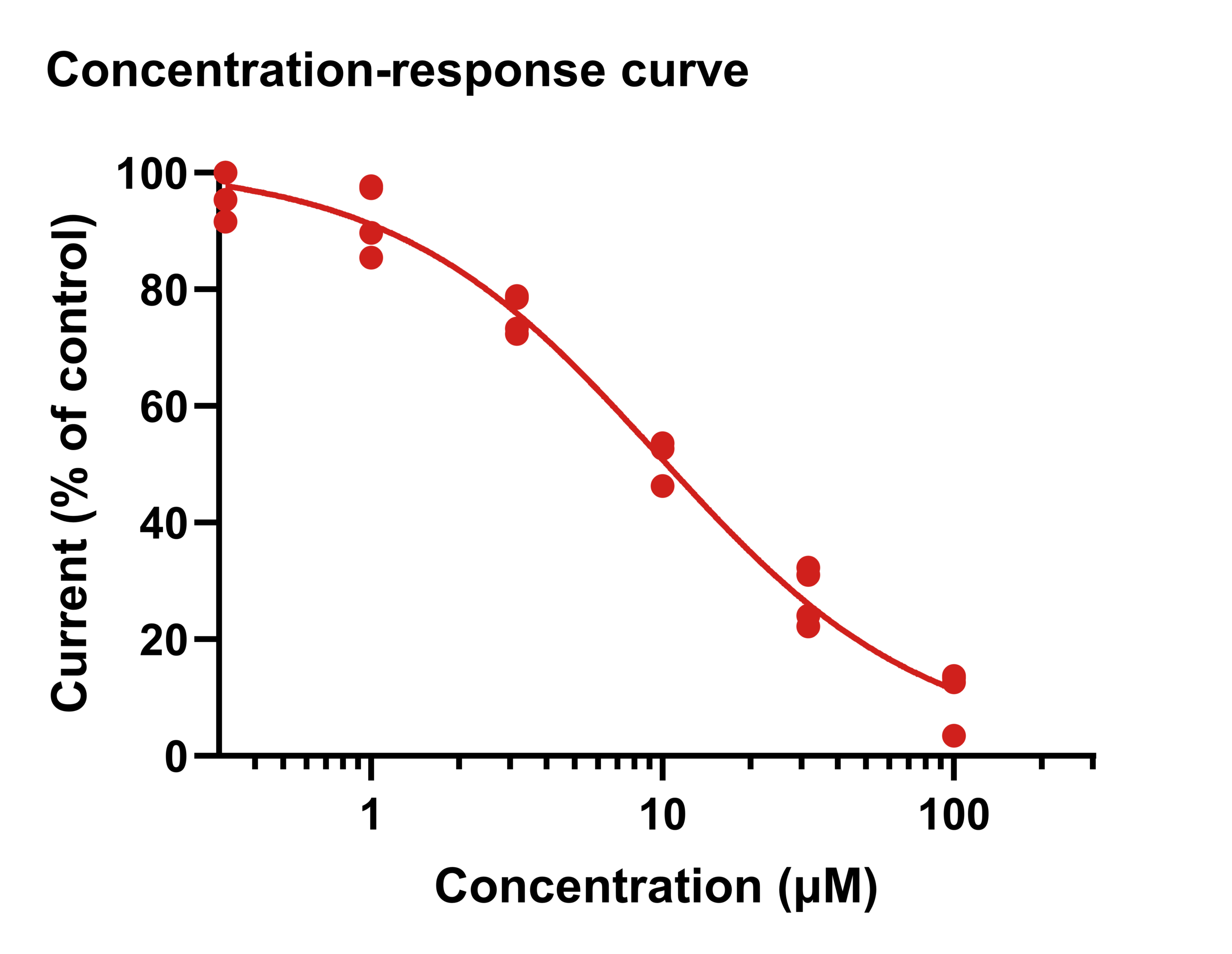
- Output data presented in a clear, graphical format and summary table of IC50 values and/or % hERG inhibition
- A specific breakdown of results with relevant information and advice on next steps (if appropriate)
- Quality Control (QC) information including comparison to a control compound, information on assay quality and named reviewer
- An invitation to discuss your results with our experts
ICH S7A Revision
The International Council for Harmonization (ICH) S7A guideline on safety pharmacology studies were first published in 2000 with the aim of protecting clinical trial participants and patients. The guidelines have not been updated in more than 25 years and, in that time, science and technology have advanced, as has the diversity of therapeutic modalities available. Accordingly, there is a drive to revise S7A guidelines. Any revision requires global consensus from industry, regulatory, and CRO stakeholders on priorities, as well as harmonization across regions and sectors. Five pillars have been identified as key:
- Modality agnostic and sustainable over time
- Functional endpoints in state-of-the-art in vivo studies
- Consideration of in silico and in vitro methods
- Consideration of adversity
- Collectively, S7A should provide an integrated risk assessment and weight of evidence