Nicholas Coltman

2026-06-23T18:09:32+01:00

Meet The Team

Dr Nicholas Coltman

Nicholas Coltman

PhD

Nicholas Coltman completed his PhD in vitro pre-clinical toxicological research through a BBSRC iCASE Scholarship at the University of Birmingham. Nicholas has extensive industrial experience, having previously worked as a scientist for both Harlan Laboratories and Sygnature Discovery. Now at ApconiX, Nicholas is the Deputy Head of Safety Science and provides support across multiple industries — for both discovery and regulatory toxicology. Nicholas enjoys translating toxicological mechanisms and DMPK into human-relevant results for risk assessment — particularly for genotoxicity, hepatotoxicity, and DART. He leads a multidisciplinary team of safety scientists and developing toxicologists and has a strong track record in mechanistic safety assessment, scientific risk evaluation and client-focused consultancy.

Peter Cotton

2025-02-12T17:32:48+00:00

Meet The Team

Peter | ApconiX

Peter Cotton

Peter is an expert clinical pathologist specialist with over 30 years of experience in big pharma.  Until recently Peter was the Chairperson of the Association for Comparative Clinical Pathology and associate editor of the Journal for Comparative Clinical Pathology.  Keeping up the tradition of many of the ApconiX team, Peter is a lecturer on the MSc Toxicology courses at the University of Birmingham and the University of Surrey.  With an excellent understanding of non-clinical study design and interpretation, Pete can propose solutions in response to complex data sets to ensure good outcomes.

Hannah Jennings

2024-12-12T09:46:05+00:00

Meet The Team

Hannah Jennings

Hannah Jennings

MSc

Hannah is part of the team working in our ion channel laboratory. Hannah graduated from the University of Liverpool, with a BSc (Hons) in Biochemistry and a MSc in Advanced Biological Sciences. Hannah carried out two research projects in tissue culture and cell signaling, with the Institute of Ageing and Chronic Disease at the University of Liverpool. A biochemist by trade, Hannah joined ApconiX 3 years ago after completing her Masters and has been building her career as an electrophysiologist within the ApconiX lab. Hannah’s responsibilities include cell line generation, assay development and patch-clamping using latest generation electrophysiology platforms to screen for hERG, CiPA, cardiac and CNS liabilities. A creative research scientist, Hannah is passionate about pre-clinical drug discovery and development, and enjoys working in the dynamic environment of ApconiX, learning more about ion channels, electrophysiology, and cell line development.

Read more about Hannah Jennings

Pauline Garner

2023-02-22T15:55:36+00:00

Meet The Team

Pauline Garner

Pauline Garner

Pauline is an experienced Genetic Toxicologist with over 24 years in non-clinical safety at a medium-sized CRO. Specialising in Programme Management for the last 9 years, Pauline combines a passion for science and pharmaceutical development, with the knowledge of project and commercial needs. Pauline has a strong reputation in communication and an eye for detail. She particularly enjoys building enduring customer relationships to support optimum delivery of non-clinical safety programmes.

Emily Johnson

2025-01-28T10:18:13+00:00

Meet The Team

Dr Emily Johnson

Emily Johnson

PhD

After completing her BSc Neuroscience (1st class, Hons), Emily studied the role of T-type Ca2+ channels in proliferative cardiovascular disease for her PhD (University of Leeds). Having cemented a love for electrophysiology, she spent 5 years working as a post-doctoral Research Fellow, utilising her expertise with patch-clamp electrophysiology, optogenetics and 2-photon Ca2+ imaging, to address novel Neuroscience research questions.  A natural problem solver and collaborative researcher, Emily has a tenacious attitude useful for acquiring high-quality, reproducible data.

The Effect of Intracellular pH on hERG Inhibition

2023-09-28T11:44:24+01:00

The effect of intracellular pH on hERG inhibition

The challenge

A valued client, BugWorks Research, approached ApconiX to help them investigate the effect of intracellular pH on the inhibition of hERG potassium channel.  At different pH, molecules might carry a different charge, depending on their structure.  This may affect the molecule’s activity at hERG. Their enquiry followed some unexpected hERG inhibition by their compounds and the discovery of a paper published in 2016 by Wang et al.  The paper showed that dofetilide, a known hERG blocker, had a quicker onset of effect at lower intracellular pH than under standard conditions.  As shown in Figure 1.
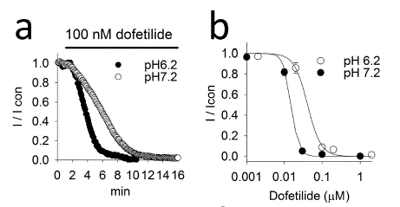
Figure 1: Decreased time to effect of dofetilide at intracellular pH 6.2 versus pH 7.2 (from Wang et al., 2016)


Figure 1: Decreased time to effect of dofetilide at intracellular pH 6.2 versus pH 7.2 (from Wang et al., 2016)

The science

Electrophysiology experiments were performed on the Patchliner automated patch-clamp system (Nanion Technologies).  These experiments showed no significant difference in the onset of dofetilide inhibition at lower intracellular pH, as illustrated in figure 2.
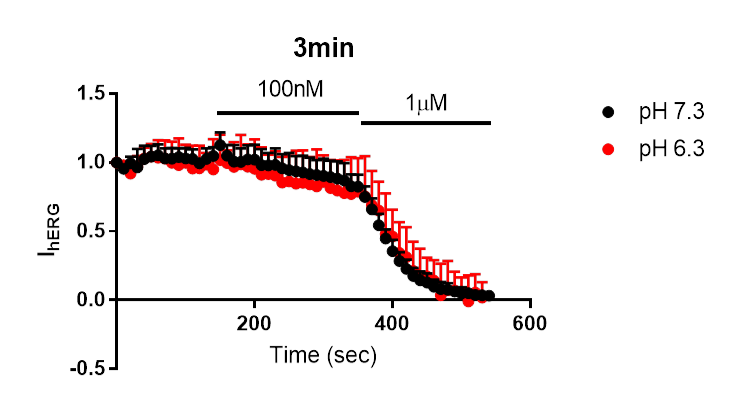
 Figure 2: No change in time to effect of dofetilide on hERG current at pH 6.3 versus pH 7.3.

Figure 2: No change in time to effect of dofetilide on hERG current at pH 6.3 versus pH 7.3.

There is limited literature in this area. ApconiX found a second paper by Du et al., 2011, which reported no effect of intracellular pH on hERG inhibition by dofetilide, contesting Wang’s original data.

The outcome

Based on data from ApconiX and others, it is unlikely that intracellular pH is affecting the onset of hERG inhibition. Changes in intracellular pH that might affect the charge of a molecule does not, in this case, explain unexpected hERG inhibition.

Du et al (2011) Enhanced inhibitory effect of acidosis on hERG potassium channels that incorporate the hERG1b isoform. Biochem Biophys Res Comm 405, 222–7

Wang et al. (2016) Role of the pH in state-dependent blockade of hERG currents. Scientific Reports 6: 32536


The Testimonial

“Your data turnaround time is incredibly good and it really helps us track the SAR and progress our compounds in a rapid and efficient manner. Thanks ApconiX for your wonderful support to Bugworks.”

V Balasubramanian, PhD, Bugworks Research India Pvt. Ltd.
Go to Top