Claire Sadler

2024-07-30T10:26:48+01:00

Meet The Team

Dr Claire Sadler

Dr Claire Sadler

PhD

Claire is an experienced project toxicologist and former Director of Discovery Safety within AstraZeneca.  Claire specialises in early project safety assessment, identifying and mitigating risks from target identification through to early clinical trials.  She has worked across multiple therapy areas including oncology, infection, immune and cardiovascular, and on many drug platforms including small molecules, proteins and novel platforms.  She has been directly involved in bringing many candidate drugs to clinical trial, submitted through different territory regulatory agencies.  She has a proven track record in problem solving and in investigational cellular and molecular toxicology.  She is expert in designing and implementing bespoke safety packages and in developing strategies to drive compound design and selection.

Michael Morton

2024-06-12T14:46:05+01:00

Meet The Team

Dr Michael Morton

Dr Michael Morton

PhD

A co-founder of ApconiX, Mike is an expert electrophysiologist and ion channel biologist with extensive experience gained in academia and industry.  Mike’s career has spanned pure research, ion channel assay development and large-scale screening of all manner of ligand- and voltage-gated ion channels.  Mike learned his craft as a postdoctoral fellow first at Leeds (with Malcolm Hunter) then at Yale (with Fred Sigworth) before joining the global ion channel initiative at AstraZeneca where his skills were applied to drug projects.  Mike has a serious passion for ion channels and enjoys working with collaborators and clients alike to ensure the highest quality data are used to support better decision-making.

Richard Knight

2025-07-29T11:22:16+01:00

Meet The Team

Dr Richard Knight

Dr Richard Knight

PhD, ERT

A co-founder of ApconiX, Richard is an expert toxicologist with more than 20 years of drug development experience gained in AstraZeneca, where he was part of the Drug Safety and Oncology Leadership Teams.  Richard has worked on projects in multiple therapy areas involving small molecules, biologics, proteins and oligonucleotides.   He has an in-depth understanding of drug discovery and drug development and has been directly involved in bringing over 35 new candidate drugs to clinical trials and 6 to marketing approval.  He uses his extensive experience to bring an innovative, science-led and pragmatic approach to the design and delivery of nonclinical safety programmes.

Ruth Roberts

2025-08-20T14:34:51+01:00

Meet The Team

Professor Ruth Roberts

Professor Ruth Roberts

PhD, ERT, ATS, FRSB, hon FBTS, FRCPath

A co-founder of ApconiX, Ruth has 25 years of experience in leading roles in drug safety within large pharma.  Ruth is also Chair and Director of Drug Discovery at The University of Birmingham, UK and was previously Global Head of Regulatory Safety at AstraZeneca.  With over 180 publications in peer-reviewed journals, she is former president of the British Toxicology Society, former president of EUROTOX, former secretary to SOT and President of the Academy of Toxicological Sciences. Ruth was the recipient of the SOT Achievement award in 2002, the EUROTOX Bo Holmstedt Award in 2009, the SOT Founders award in 2018 for outstanding leadership in toxicology and the ATS 2022 ‘Millie’ award for lasting impact on translational science. Ruth is an established science professional bringing rigorous expert thinking to toxicology, drug discovery and drug development.

Jane Barber

2024-06-12T14:46:58+01:00

Meet The Team

Dr Jane Barber

Dr Jane Barber

PhD

Jane is an experienced investigative and project toxicologist with expertise in cancer research, molecular toxicology and discovery project toxicology and has worked across multiple therapy areas including oncology.  Jane has experience in evaluating the safety of drug targets and has extensive experience in mechanistic problem solving and in discovery project toxicology. Jane has a specialist expertise in hepatotoxicity, in vitro and in vivo problem solving, study design and reporting and has led global scientific strategy teams developing pre-clinical toxicity packages for mitigating the risk of transporter hepatotoxicity in discovery and development projects.

The Effect of Intracellular pH on hERG Inhibition

2023-09-28T11:44:24+01:00

The effect of intracellular pH on hERG inhibition

The challenge

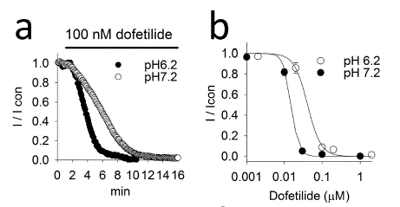
A valued client, BugWorks Research, approached ApconiX to help them investigate the effect of intracellular pH on the inhibition of hERG potassium channel.  At different pH, molecules might carry a different charge, depending on their structure.  This may affect the molecule’s activity at hERG. Their enquiry followed some unexpected hERG inhibition by their compounds and the discovery of a paper published in 2016 by Wang et al.  The paper showed that dofetilide, a known hERG blocker, had a quicker onset of effect at lower intracellular pH than under standard conditions.  As shown in Figure 1.

Figure 1: Decreased time to effect of dofetilide at intracellular pH 6.2 versus pH 7.2 (from Wang et al., 2016)


Figure 1: Decreased time to effect of dofetilide at intracellular pH 6.2 versus pH 7.2 (from Wang et al., 2016)

The science

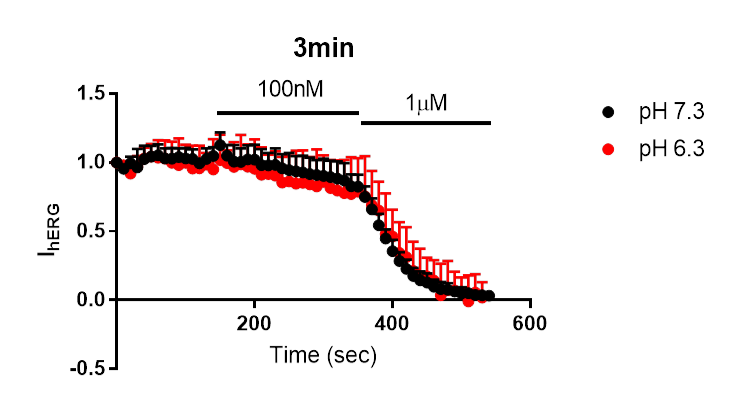
Electrophysiology experiments were performed on the Patchliner automated patch-clamp system (Nanion Technologies).  These experiments showed no significant difference in the onset of dofetilide inhibition at lower intracellular pH, as illustrated in figure 2.

 Figure 2: No change in time to effect of dofetilide on hERG current at pH 6.3 versus pH 7.3.

Figure 2: No change in time to effect of dofetilide on hERG current at pH 6.3 versus pH 7.3.

There is limited literature in this area. ApconiX found a second paper by Du et al., 2011, which reported no effect of intracellular pH on hERG inhibition by dofetilide, contesting Wang’s original data.

The outcome

Based on data from ApconiX and others, it is unlikely that intracellular pH is affecting the onset of hERG inhibition. Changes in intracellular pH that might affect the charge of a molecule does not, in this case, explain unexpected hERG inhibition.

Du et al (2011) Enhanced inhibitory effect of acidosis on hERG potassium channels that incorporate the hERG1b isoform. Biochem Biophys Res Comm 405, 222–7

Wang et al. (2016) Role of the pH in state-dependent blockade of hERG currents. Scientific Reports 6: 32536

The Testimonial

“Your data turnaround time is incredibly good and it really helps us track the SAR and progress our compounds in a rapid and efficient manner. Thanks ApconiX for your wonderful support to Bugworks.”

V Balasubramanian, PhD, Bugworks Research India Pvt. Ltd.

Gilead Sciences

2019-01-09T13:30:10+00:00

“Working with ApconiX has been effortless! They have provided high quality target safety assessments with a focus on comprehensive interpretation of findings. The information provided has helped contribute to decisions on activities when moving early molecules forward. ApconiX constantly meets or exceeds timelines, while still providing flexibility to fit in last minute requests without impacting previously scheduled work. It has been a pleasure to work with Ruth and her team.”

Gilead Sciences

A Company Focused on Novel Oncology Targets

2021-06-10T14:51:11+01:00

A Company Focused on Novel Oncology Targets

The challenge

Our client had identified a clinical candidate aimed at a novel tumour target, with promising activity against a range of cancers.  Upon completion of suitable GLP toxicity studies, the company intended to move into Phase I in patients, in combination with chemotherapy. There were a number of pressing issues, including choice of the appropriate nonclinical species, dosing schedule, achieving adequate exposure as well as the potential for greater target organ toxicity when dosed in combination.

The solution

ApconiX joined the client’s project team by providing a dedicated project toxicologist, supported by our other experts.  With a clear understanding of the project goals and clinical objectives, we delivered a bespoke, focussed nonclinical safety package designed to ensure the right data were provided for regulatory success and rapid initiation of the Phase I patient studies.

A study that provided safety and DMPK data on the novel agent dosed with chemotherapy was also designed and conducted. Although not a regulatory requirement, this allowed a better understanding of the impact of the combination and supported a higher start dose in combination with chemotherapy.

ApconiX managed all aspects of the preclinical safety package, working closely with CROs to ensure appropriate study design, costs, dose level selection, data interpretation as well as timely delivery of quality study reports.  Concurrently, we authored the nonclinical sections of the regulatory submission documents and represented the client at a regulatory agency meeting.

The benefit

With ApconiX as part of the team, our client benefited from our many years of collective experience in preclinical safety, DMPK and drug development.   The package was designed to ensure regulatory and clinical objectives were met, keeping to budget and agreed timelines.

The outcome

The Clinical Trial Authorisation was approved, allowing the compound to move into clinical trials, in combination with chemotherapy.  During this phase, we also assisted in the out-licencing of this asset to a third party.   We continue to work with the new owners to ensure its further success.

Blueberry Therapeutics

2020-01-23T09:23:37+00:00

“The support that we received from the ApconiX team has been excellent and they have helped us both in developing our nonclinical safety thinking and in providing direct support for the clinical trial application. We’re looking forward to continuing our collaboration as we progress our exciting new medicines into later-stage development and hopefully the clinic”

Dr. David Cook, Chief Scientific Officer, Blueberry Therapeutics
Go to Top